


During last weekend’s sermon, Pastor Adam referenced the statue at the United Nations building, “Let us Beat our Swords into Ploughshares” by the Russian sculptor, Yevgeny Vuchetich. The statue was a gift to the U.N. by the U.S.S.R. in 1959. 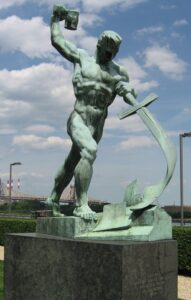
In High School, I participated in a Model United Nations program in which students imitated the proceedings at the U.N. & spent several weeks researching the interests & ideals of their randomly assigned country. My Senior year, I was a delegate for the Soviet Union & referenced this statue in my opening speech. (Since this was at the height of the Cold War in the early 1980’s, representing the U.S.S.R. wasn’t an easy gig.)
Aside: President Reagan’s favorite joke about Communism. In Russia, you have to wait 10 years for delivery of a new car. The customer asks, “Will it be in the morning or afternoon?” The salesman says, “What difference does it make? It’s 10 years from now.” The customer replies, “Well, the plumber is coming in the morning.”
Forty years later, this statue still resonates with me. Let’s consider 2 themes:
In my speech, I emphasized the lofty ideals the sculpture conveyed, while trying to get off the podium before anyone brought up the awkward contradictions it represented:
Upon reflection, though, I would contend that the context of this statue highlights the human condition. We, too, strive to live out lofty ideals & often fall short. We set a goal to do the right thing, say the right thing, & think the right thing each morning & recognize by the end of the day that we really struggled. Fortunately, as Paul notes in today’s passage, God still loves us even in the midst of our stumbles. Each morning, though, we once again renew our hope to be a good & faithful servant.
Aside: I like the old Preacher’s prayer: “Lord, I have been perfect today. I was patient & kind to everyone I met. I made sure that everything I did was according to Your will. Now, help me maintain this streak of excellence as I get out of bed & take my morning shower. Amen.”
The second theme that stands out to me is that the sculpture doesn’t bury the sword in the ground or throw it into a river. The statue echoes Isaiah & the sword is transformed from a weapon of violence into a tool of productivity.
While we may no longer carry literal swords, we often do attack people with sharp words, sharp temper, or even carry sharp resentments. But what if we converted our “swords” into a plough that encourages patience, fosters reconciliation, & aims for peace in all of our daily interactions?
Of course, this message isn’t just for nations & governments. It is also for dining rooms, work breakrooms, & even online. Perhaps today is a good day to try to be quiet blacksmiths of grace–reshaping our harsh “weapons” of violence into “ploughs” of peace.
Now if you’ll excuse me, all this global relations thinking has me desiring some food with an intercontinental flair: “Doris, tonight we dine at the International House of Pancakes.”
For more on the history and details of the sculpture, visit https://www.un.org/ungifts/let-us-beat-swords-ploughshares#:~:text=The%20sculpture%20was%20gifted%20to,behalf%20of%20the%20United%20Nations
