
Due to potentially damaging weather this afternoon and evening, the children’s musical and pre-show events in the Leawood Sanctuary have been cancelled and will be rescheduled.
Scheduled programming has resumed for Thursday, February 13 at all Resurrection locations.

Genesis 12
1 The LORD said to Abram, “Leave your land, your family, and your father’s household for the land that I will show you. 2 I will make of you a great nation and will bless you. I will make your name respected, and you will be a blessing.
3 I will bless those who bless you,
those who curse you I will curse;
all the families of the earth
will be blessed because of you.”
7 The LORD appeared to Abram and said, “I give this land to your descendants,” so Abram built an altar there to the LORD who appeared to him.
Genesis 15
1 After these events, the LORD’s word came to Abram in a vision, “Don’t be afraid, Abram. I am your protector. Your reward will be very great.”
2 But Abram said, “LORD God, what can you possibly give me, since I still have no children? The head of my household is Eliezer, a man from Damascus.” 3 He continued, “Since you haven’t given me any children, the head of my household will be my heir.”
4 The LORD’s word came immediately to him, “This man will not be your heir. Your heir will definitely be your very own biological child.” 5 Then he brought Abram outside and said, “Look up at the sky and count the stars if you think you can count them.” He continued, “This is how many children you will have.” 6 Abram trusted the LORD, and the LORD recognized Abram’s high moral character.
7 He said to Abram, “I am the LORD, who brought you out of Ur of the Chaldeans to give you this land as your possession.”
God gave Abram (later Abraham) a sweeping promise: “I will make of you a great nation—I will give this land to your descendants.” But in Genesis 15, God said, “Don’t be afraid, Abram.” What was there to fear? Abram wasn’t sure he could trust God’s promise—he said, “I still have no children.” (He waited 25 years for the promised child–Genesis 12:4 and 21:5.) God’s call not to fear was a call for patient trust. When Abram “trusted the Lord,” that kept him going, as it can keep you going when you have to wait for anything important to you.
Prayer: Lord Jesus, teach me how to view life through the lens of eternity, as you do. Help me to trust that there are vast spheres that lie far beyond my immediate ability to see or understand. Amen.
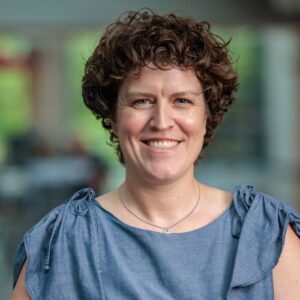
Valerie Nagel, who serves as a Connection and Care Pastor at Resurrection Leawood, wrote today's Insights. A Californian by birth, her Master of Divinity degree is from Duke Divinity School. She served in the Rio Texas Conference from 2011 in the Austin area and San Antonio. From congregational care and welcoming guests to leading in worship, Valerie loves the local church's ministry. She juggles ministry with being a mom to Caleb (born 2012) and Jacob (born 2015), friend, avid reader, lover of the outdoors, beginner in CrossFit, and foodie.
When I was in high school and college, I saw my faith through a black and white lens. My faith was focused on an intellectual acceptance of God’s love for me and the world. I read things like, “Don’t be afraid, Abram” and said to myself, “God is God therefore I can and will trust God.” I wanted it to be that simple. Faith is more nuanced than simply telling myself something. Faith is lived each and every day and trust is built over time. There will be moments on our faith journey that require us to be courageous. There are moments when we are invited not only to hope, but to step out in faith and follow God into a future that feels surprising, unknown, or even a bit scary.
What I’ve come to see as an adult (and I didn’t understand as a teenager) is the vulnerability of God’s words–“Don’t be afraid, Abram. I am your protector. Your reward will be very great.” God invited Abram, and God invites us, to trust God and to grow in our relationship with God. Would Abram believe God? Would Abram trust God? Do I believe God? Do I trust God? A loving, deep, and meaningful relationship requires vulnerability and trust. Dr. Brene Brown has written and spoken extensively on vulnerability. She said, “Vulnerability is the birthplace of love, belonging, joy, courage, empathy, and creativity.” It is courageous to show up in the midst of feeling afraid and to say yes to following where God leads.
Pastor Adam reminded us in his sermon yesterday what a risk it felt like that first Christmas Eve when our church discerned that we should give 100% of our special offering away. In his sermon, he shared a quote by Mark Zuckerberg who shared that the best advice he ever received was “the biggest risk you take is not taking any risk.” What a joy it is to remember how much we have given away over the years. This past Christmas we gave $2,338,504.08. We might feel afraid, but when we discern how God is leading us, will we remember God’s faithfulness? Will we follow wherever God leads? Will we take a risk?
* Alister McGrath, “I Believe”: Exploring the Apostles’ Creed. Downers Grove, IL: IVP Books, 1997, p. 22.
