WEATHER ALERT:

Due to potentially damaging weather this afternoon and evening, the children’s musical and pre-show events in the Leawood Sanctuary have been cancelled and will be rescheduled.

IMPORTANT:

Scheduled programming has resumed for Thursday, February 13 at all Resurrection locations.

Jesus' Hard Sayings About Integrity of Heart

April 30, 2026
SHARE

Daily Scripture

Matthew 5:27-37

27 “You have heard that it was said, Don’t commit adultery [Exodus 20:14, Deuteronomy 5:18]. 28 But I say to you that every man who looks at a woman lustfully has already committed adultery in his heart. 29 And if your right eye causes you to fall into sin, tear it out and throw it away. It’s better that you lose a part of your body than that your whole body be thrown into hell. 30 And if your right hand causes you to fall into sin, chop it off and throw it away. It’s better that you lose a part of your body than that your whole body go into hell.
31 “It was said, ‘Whoever divorces his wife must give her a divorce certificate’ [Deuteronomy 24:1]. 32 But I say to you that whoever divorces his wife except for sexual unfaithfulness forces her to commit adultery. And whoever marries a divorced woman commits adultery.
33 “Again you have heard that it was said to those who lived long ago: Don’t make a false solemn pledge, but you should follow through on what you have pledged to the Lord [Leviticus 19:12; Numbers 30:2; Deuteronomy 23:21]. 34 But I say to you that you must not pledge at all. You must not pledge by heaven, because it’s God’s throne. 35 You must not pledge by the earth, because it’s God’s footstool. You must not pledge by Jerusalem, because it’s the city of the great king. 36 And you must not pledge by your head, because you can’t turn one hair white or black. 37 Let your yes mean yes, and your no mean no. Anything more than this comes from the evil one.

Daily Reflection & Prayer

In the Sermon on the Mount, Jesus took up painful topics: adultery and lust, divorce, and oath-taking. Like Israel’s prophets, he taught that God cares about our hearts, not just our actions. These hard teachings have caused much pain when misapplied. Jesus wasn’t creating new legalistic rules but calling his followers to be utterly serious about faithfulness, covenant-keeping, and honesty. God and everyone else, especially those who love and trust us, should always be able to depend on our word.

  • Jesus wasn’t literally telling you to mutilate your body in verses 29-30. As one scholar noted, “Cutting off an offending member would not necessarily end one’s sin. Jesus here uses hyperbole, or rhetorical overstatement, to graphically underline his point: do whatever is necessary to evade destruction.” * What can Jesus’ startling images teach you about taking your inner life seriously? What destructive habits or wishes might Jesus call you to “amputate”—to radically remove from your life? What makes this difficult?
  • Jesus spoke tersely about divorce here. Other passages (Matthew 19:3–9, Mark 10:2–12, Luke 16:18, 1 Corinthians 7:10–16) gave more nuanced help for the hard reality of broken marriages. Jesus never aimed to shame those whose marriages have failed (see John 4:16-26). “Jesus certainly didn’t want his hearers, or the later church, embroiled in endless debates about just what was allowed…. Jesus is not just giving moral commands. He is unveiling a whole new way of being human.” ** If your promises (marital or other) were always trustworthy, how would that lead you toward Jesus’ vision of a whole new way of being human?
Prayer

Lord Jesus, your hard sayings challenge me to take faithfulness seriously—in my thoughts, my commitments, and my words. Keep me growing in integrity so my “yes” means yes and my “no” means no. Shape me into a person others can always trust. Amen.

GPS Insights

Picture of Janelle Gregory

Janelle Gregory

Janelle Gregory, who serves as Resurrection's Human Resources Lead Director, wrote today's Insights. Janelle finds that her heart is constantly wrestling with the truth that she needs a Savior, and the times when she's at her very best are when she's just too tired to put up a fight.


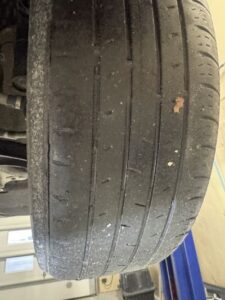
As I drove on the wintery roads a few months ago, I realized I didn’t have the traction I thought I should have. I was slipping and sliding more than usual. At one point, I nearly got into a wreck. So, I took my car into the shop. The service team showed me a picture of my tires. They were worn and cracked. “Your alignment was off,” they explained. “It’s been off for a while. You can see where it’s been wearing on your tires.” Yikes! They got me fixed up, but it cost me two new tires and a realignment (cha-ching!).
But here’s the thing; I didn’t know my alignment was off. It’s not like you get into your car one day and suddenly veer hard to the right. It starts by being slightly off. You can still move forward with some minor adjustments. You learn to compensate for the pull without even realizing you’re doing it. And all the while, whether you notice it or not, the damage is h
appening underneath the surface.
We tend to think the real problems are the big, visible moments–the blowouts and the breakdowns. But more often than not those moments are simply the result of something that’s been out of alignment for a long time.
It starts internally, when we allow our minds to drift. We entertain thoughts we know we shouldn’t. We tell ourselves that it isn’t a big deal. Nobody can see it and, technically, nothing has happened. We keep moving forward with some minor adjustments. But just like a car, internal misalignment has a way of showing up eventually. Those small internal shifts can lead to much bigger external consequences. Not because everything falls apart at once, but because the direction over time matters more than any single moment. A slight pull, left unaddressed, doesn’t stay slight.
The good news is that alignment in our souls, just like alignment in our cars, can be corrected. It requires a willingness to stop and acknowledge that something isn’t quite right, even if it appears fine from the outside. It might mean getting really honest with ourselves. It might mean making a change that is inconvenient or uncomfortable. But the alternative is that if we do nothing, we’re constantly compensating, slowly wearing things down, and hoping it doesn’t catch up to us.
Thankfully, God isn’t standing off to the side waiting for the breakdown to happen so that he can say, “I told you so.” He’s inviting us into the shop before things get worse, gently pointing out what we couldn’t see on our own. He sees where we are drifting, and he’s ready to realign, doing so with grace and care. Because the goal isn’t just to get us back on the road, it’s to set us straight so that where we’re headed actually matches where we want to go.
© 2026 Resurrection: A United Methodist Church. All Rights Reserved.
Scripture quotations are taken from The Common English Bible ©2011. Used by permission. All rights reserved.
References

* Craig Keener, comment on Matthew 5:30 in Cultural Backgrounds Study Bible (p. 8804). Zondervan. Kindle Edition.
** Wright, N.T., Matthew for Everyone, Part 1: Chapters 1-15 (The New Testament for Everyone) (pp. 48-49). Westminster John Knox Press. Kindle Edition.