We began our day with coffee and breakfast around the table, where a coffee pot overflowed…much like God’s love for us (of course, we must have a metaphor in here somewhere!).
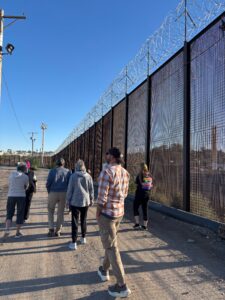
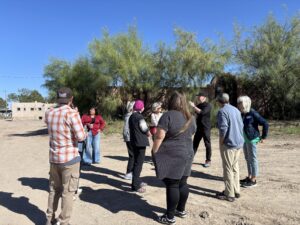
We spent the day learning at Abara with Jon, Nate, Sami, Becky, Michael, Clara, Daniela, Luna, and Sal (and many stray cats). Our day unfolded on the Abara House and property, which sits just 20 feet from the border fence. This site is a historic crossing below the original fall line of the Rio Grande River. Over centuries, this crossing has seen Indigenous communities, Spanish colonists, Anglo settlers, Chinese laborers, enslaved African Americans, Buffalo Soldiers, Mexican families, Braceros, and today, migrants, asylum seekers, and global refugees. The Hacienda, which Abara purchased four years ago, is a historic adobe structure.
We walked around the wall and noticed camera towers with a five-mile reach…enough to spot someone reading a book two miles away. The staff emphasized that Border Patrol always knows if someone crosses here. It was a surprise to me that the border fence does not span the entire U.S.–Mexico border, but only where natural terrain does not act as a barrier. Border Patrol trucks frequently patrol the area, and barbed wire has been added to the top.
We began by reflecting on Habakkuk’s Complaint: “Why do you make me look at injustice? Why do you tolerate wrongdoing?” These are questions I believe many of us ask.
We then listened to Migrants—Liturgies from Below by Claudio Carvalhaes, which was incredibly powerful:
“Is my blood not like yours: crimson red, life that flows through the veins? Are my salty tears not like yours, crying at what hurts, what pains me? Does my body not need the same food you need for yours, and does your life not need the same dignity that I desire for mine and for my sons and daughters? Are my dreams and hopes not as valuable as what you have? Does your heart not beat, just like mine, when you embrace someone you love? …Do you think it makes me happy to have to migrate, leave my land, my history, my roots? I do not fear the barred borders, nor the walls that so many insist on building. I fear the border of love incapable of including, the limits of a compassion that hides one’s hand, the gates of looks that hate, judge, and condemn. …Please, look at me as if you were looking at a mirror, for if you recognize me as human, your brother, your sister, you will be wearing your own existence of humanity.”
The staff introduced us to Abara’s mission and history. Since its founding, Abara has hosted thousands of participants and works with many migrant shelters. On their wall, Abara has written: “We dream of a world without ‘others,’ where fear gives way to connection and every person’s humanity is fully honored.”
We also explored the history of the border, the development of Border Patrol, personal stories, and the interns’ experiences growing up in the Borderlands. The discussion traced border development through historical episodes, including migration policies in the 19th and 20th centuries, exclusion laws affecting Chinese immigrants, and modern transit routes such as the Darien Gap. The Darien Gap is a dense, roadless jungle region between Panama and Colombia, considered one of the most dangerous migration routes in the world. Migrants travel it on foot, facing risks such as disease, flooding, wildlife, and criminal activity. Most migrants today come from countries other than Mexico, and many face significant risks during their journey. Recent policy changes have affected how migrants enter and are processed at the border.
The interns shared how shaping it was to navigate the tension of being proud of their culture and Juárez, while pulled between two worlds. Dani’s dad worked in El Paso to provide for her family, but he wasn’t around often and would sometimes miss birthday parties. Dani is currently applying for U.S. citizenship. Luna loved living in Juárez due to her community, but was grateful to be a citizen of the U.S.. She explained that she can be loud and proud of her heritage because she has the protection of citizenship, while Dani and Becky cannot. They must be careful, and crossing the border daily carries the potential for fear and uncertainty. The interns also shared a little about the political history of Mexico, the Drug War, and femicides.
Some people say, “the border crossed me,” meaning that the walls, policies, and restrictions affect lives, opportunities, and emotions far beyond its physical line. The walls along the border are more than physical barriers—they reflect walls in our hearts. As Michael shared, it is possible to maintain protected borders while also practicing fair and compassionate policies.
We discovered that many stories in the media are misleading or incomplete. Migrants contribute significantly to local economies and entrepreneurship, and their work supports communities in many ways.
Did you know that El Paso is considered one of the safest large cities in the U.S.? In contrast, in 2024, Ciudad Juárez was ranked the 13th most violent city globally—a significant improvement from being the most violent city in the world in 2010. Although they are two different cities in two different countries, they often appear to blend into one another.
I sat on a step in the middle of our day, peering over into Juárez, thinking about all the life being lived on the other side and knowing that we would be going there tomorrow to experience more and hear more of those realities. We left the day with much to reflect on.
Back at our apartments, a local woman had prepared enchiladas, rice, and beans for dinner, and I can’t forget the lunch that Abara arranged from a local family: Pork Chile Verde with Potatoes, spicy but delicious.
Our devotional included part of the Wesley Covenant Prayer, shared by Angie: “put me to doing, put me to suffering.” We reflected on the suffering we had learned about that day, connected it to our own stories, and discussed how it shapes our ability to sit with people during their suffering. We are all cracked pots after all. Our debrief lasted an hour and a half, our longest yet.
It was a long, but profoundly important, day.