The day started a little earlier than usual because today we were going into Juárez, Mexico. We began at Abara, where Clara spoke with us about Dignified Storytelling and what to expect for the day.
We crossed the border by van, which, surprisingly, was incredibly easy compared to getting into the U.S. On the other side, we met the Abara Juárez staff: Daniel, Rosa, Toya, and Danielle, along with Jon. Later, Felix joined us, and yes, they had amazing Mexican snacks.
Rosa spoke to us entirely in Spanish, with Toya translating, about the migrant shelters in Juárez. She called Juárez “the most wonderful border city in the world,” because of how welcoming it has been to those waiting to enter the U.S. The migrant population served there doubled from 9,620 in 2020 to 22,776 in 2021, and by 2023 most were from Venezuela.
Next, we visited a shelter called San Oscar Romero, where we shared lunch, pizza and spaghetti, a true carb overload, and we were definitely all gaining weight from how well they fed us. Breaking bread while learning about these human experiences is our favorite thing. We played a few games and laughed with ten migrants from Venezuela, Brazil, and Colombia. There was a language barrier, but we made it work with mostly Spanish attempts, but sprinkles of Google Translate magic.
Angie and I sat with a couple named Jesús and Melanie from Venezuela, and their story broke us. They were married and had three children, but two had to stay behind in Venezuela because it was too dangerous to bring all of them through the jungle, which I think they meant was the Darién Gap. Jesús told us it took them three days to cross, swimming, climbing, and surviving in the wild. They saw tigers, huge spiders, venomous snakes, and people around them falling from rocks, drowning in rivers, disappearing in the dark. They had now been at the shelter for a year, unable to work or move forward, just waiting, living in limbo and uncertainty.
Melanie began to cry twice while sharing their story; she misses her children terribly and dreams of bringing them here someday. Despite everything, both she and Jesús smiled often, laughed with us during our Jenga game, and even teased me about finding a Venezuelan boyfriend, saying, “We’ll text them and say there’s a gringa from Kansas City waiting.” They also asked what it was like to “fall in love” in the United States. Without missing a beat, I said, “No sé!” (I don’t know!) — Angie would have to answer that one. In the moment, it felt hilarious, but now that I reflect on it, I feel a pang of sadness. It’s clear their marriage has not been easy, and they haven’t had the kind of joyful years together that many imagine having in the U.S. We have the life they probably long for. We found out Melanie and I are the same age. She and Jesús were shocked when I said I didn’t have kids, while her oldest is already ten. That moment hit me: two women, the same age, living completely different lives divided by chance and circumstance and all because of where we were born.
Joan shared that the man she spoke with simply wanted a better life for his family. He pleaded, “Please, tell your government to help us so we can have a better life for our family.” We relayed their message to our couple and to others they had met, saying, “Thank you for sharing your stories. We are so sorry. We will pray for you.” I think we are all leaving changed by what we witnessed and experienced today.
After leaving the shelter, we went to Mile Marker 1, the spot where the Mexico–U.S. border fence changes direction because the river bends north. Historical markers there describe how this area and its boundaries were shaped by the conflicts following the 1848 Treaty of Guadalupe Hidalgo, struggles that later helped spark the Mexican Revolution. Technically, if you cross the yellow markers, you are already in the U.S., even though you haven’t reached the fence yet, and yes, you will have “problems” if you get caught. Adam mentioned that last year, Border Patrol pulled up and questioned them at this very spot. We also saw an area off to the side where Jon said migrants sometimes wait for days until the coast is clear to attempt a crossing.
We took photos by the monument, and a few of us hiked almost to the top of the mountain, with Adam going up the farthest. It was slightly dangerous, but a great view and a great workout.
Next, we explored downtown Juárez. We saw La Bestia, the freight train that many migrants used to ride north historically. We took pictures by the colorful Juárez sign, then visited a beautiful old church where we sang How Great Thou Art. Walking around downtown, we saw children asking for food money and stray dogs running through the streets, small but sobering reminders of the realities people live with here.
Dinner was at La Nueva Central, which served Chinese, Mexican, and American food all at once. Most of us ordered Horchata or Mexican Cokes, a true treat. As for food, we ordered a variety, but I went straight for the boneless wings with ranch…oh how I missed them, little masterpieces of deliciousness
Over dinner, we got to know the Abara staff more deeply. Rosa shared that she was deported from Chicago nine years ago and has never met her grandchildren because she can’t return to the U.S. Yet she continues to serve others in Juárez with so much love and strength. Felix, who is from Cuba, told Joan he had just been deported two weeks ago.
Every person we met today was kind and welcoming, yet behind their smiles were stories of trauma, loss, and survival that most of us can barely imagine. We said goodbye to the Abara Juárez team, all of us physically and emotionally drained. I know I was so tired from working my Spanish brain all day.
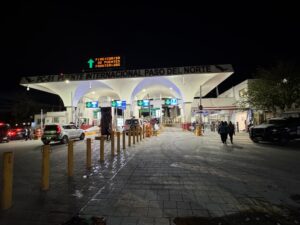
We were dropped off at the border bridge and decided to walk back to El Paso through the “bridge”, to experience what so many people and students do daily. We got our quarters, paid the toll, and began walking across. Halfway over, a man played guitar while a woman and her two kids stood nearby. Two Border Patrol agents gave our passports a quick glance but did not stop us. These are the same officers who now stop migrants without papers in the middle of the bridge, preventing them from claiming asylum and forcing them to turn back.
We were lucky, no long lines, no questions except for Angie. They asked her, “Where are you from? Why were you in Mexico? Are you bringing anything into the U.S.? Did you enjoy Mexico?” I was struck by how easy it was for us, because we are white, American, and carrying passports. Adam said the lines were shorter this year and there weren’t as many people in the middle of the bridge.
Back in El Paso, we regrouped with Jon and headed to our apartments. It was my turn, yes me, to lead the evening devotion. I joked on the ride back that, after our long day, I had cut it down to just two hours. I had planned something completely different, but after everything we had seen and experienced, I felt called to change it.
I spoke about how history repeats itself, as Chuck Palahniuk said, “If you watch closely, history does nothing but repeat itself. What we call chaos is just patterns we haven’t recognized.” Borders, policies, barriers, they are all patterns. None of us chooses where we are born, but we do choose how we respond.
We have a responsibility to speak, to educate ourselves, to share experiences, and to care for our neighbors.
“For I was hungry and you gave me something to eat, I was thirsty and you gave me something to drink, I was a stranger and you invited me in…” — Matthew 25:35–40
As Martin Luther King Jr. said, “Injustice anywhere is a threat to justice everywhere.” And as Pastor Martin Niemöller reflected after World War II, silence in the face of injustice allows harm to spread unchecked, and if we don’t do or say something, who will?
So, what will we do with what we have seen and learned? How will we respond to the needs right in front of us, here and back home? Who is our neighbor today?
Let us not wait until it is too late to speak, to act, and to show mercy. May our choices reflect compassion, courage, and justice, remembering that even small acts can break harmful patterns and make a real difference.
It was a heavy day, and we all debriefed with a mix of sadness, anger, and gratitude for having met the incredible people we did.